


 0
0
3PL vs In-House Warehousing: Which is Right for Your Business in Singapore?

By ZoomZoomShip Editorial Team | Updated March 2026 | 14 min read
Here’s the situation a lot of Singapore business owners find themselves in: you started packing orders from your HDB or office pantry. Then you rented a small storage unit. Now things are getting serious — your team is exhausted, SLAs are slipping, and someone suggested you look into a 3PL Warehousing Fulfilment in Singapore.
So you Googled it. And now you’re here, weighing up whether to sign a warehouse lease or hand your inventory to someone else entirely.
Good news: this is actually one of the easier business decisions to reason through — once you have the right framework. Let’s walk through it properly.
Table of Contents:
1. What’s the Difference Between 3PL and In-House Warehousing?
2. The Real Cost Comparison (No Sugarcoating)
3. Pros and Cons of Each — Honestly
4. Who Wins in Each Scenario?
5. The Verdict: Which Should You Choose?
6. When Should You Switch from In-House to 3PL?
7. Frequently Asked Questions (FAQ)
What’s the Difference Between 3PL and In-House Warehousing?
Think of it this way. In-house is like buying a car — you own it, you maintain it, and it’s there even on days you don’t drive. 3PL is like a really reliable Grab driver who always shows up, scales with how often you need rides, and sends you a clean invoice at the end of the month.
Neither is universally ‘better.’ The right answer depends entirely on your order volume, growth stage, product type, and how much operational complexity you actually want to own. That’s what the rest of this guide unpacks.
The Real Cost Comparison (No Sugarcoating)
One of the biggest mistakes businesses make when evaluating this is comparing headline numbers — ‘my warehouse costs SGD 4,000/month’ — without accounting for the full cost stack. Let’s put both options on the table properly.
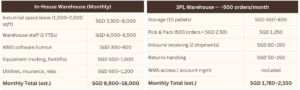
The math starts to shift as you scale. At very high order volumes (5,000+ orders/month), in-house can become cost-competitive — but by then you’re also looking at enterprise-level operational complexity. For most Singapore SMEs shipping under 3,000 orders a month, 3PL almost always wins on total cost.
Pros and Cons of Each — Honestly
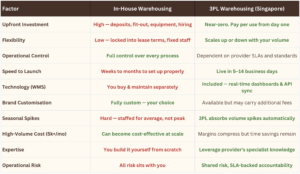
We’ll be straight with you — most 3PL providers would write this section with a heavy thumb on the scale. We’re going to try not to do that. Here’s an honest look at both:
Who Wins in Each Scenario?
The Verdict: Which Should You Choose
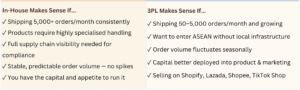
Here’s a fast decision framework. Answer these five questions honestly:
The 5-Question Decision Framework
[3PL] Do you ship fewer than 5,000 orders per month? If yes, 3PL almost certainly wins on cost.
[3PL] Is your volume seasonal or unpredictable? 3PL absorbs the spikes. In-house makes you overstaff for peaks.
[IN-HOUSE] Do you have highly unusual handling requirements that no 3PL in Singapore can match? In-house may be your only option.
[3PL] Are you expanding into new markets (Malaysia, Indonesia, Philippines)? A Singapore 3PL hub gets you there in days, not months.
[3PL] Would that warehouse capital be better deployed into marketing, inventory, or product? Almost always yes in early growth stages.
If you answered mostly orange: ZoomZoomShip’s 3PL warehousing service is worth a conversation. If you answered mostly blue: you’re at a scale where in-house may genuinely make sense — and we’d still recommend a 3PL cost comparison before signing a lease.
When Should You Switch from In-House to 3PL?
Sometimes the ‘which is better’ question is actually ‘we’re already in-house — when do we know it’s time to move?’ These are the clearest signals:
• Your error rate is creeping up. Mis-picks, wrong addresses, late dispatches — symptoms of a fulfilment operation running near its ceiling.
• You’re dreading every peak season. If 11.11 or Hariraya fills you with dread rather than excitement, your warehousing setup is costing you revenue.
• Your lease is up for renewal. This is the natural moment to re-evaluate. A 3-year renewal is a long commitment — at least get a 3PL quote before you sign.
• You want to sell regionally but can’t fulfil regionally. A Singapore 3PL warehouse changes this overnight via Lazada, Shopee, and regional carriers.
• Your team spends more time packing than growing. If talented people are doing repetitive manual tasks, you’re misallocating your most expensive resource.
Still on the Fence? Let’s Run the Numbers Together.
Tell us your monthly order volume and current setup — we’ll give you a straight cost comparison. No hard sell. No obligation. Just clarity.
Frequently Asked Questions
Is 3PL cheaper than in-house warehousing in Singapore?
For most businesses shipping under 5,000 orders per month, yes. 3PL is usually cheaper once you account for lease, staff, WMS, equipment, utilities, and management time. Singapore’s high industrial real estate costs make this especially noticeable.
Can I use a 3PL in Singapore just for overflow during peak season?
Yes. Many businesses use 3PL as overflow support during peak periods like 11.11, Hariraya, or Christmas. It’s often a stepping stone before moving to full 3PL.
What’s the minimum order volume to make 3PL worthwhile in Singapore?
Most 3PL providers become cost-effective at around 100 to 200 orders per month. Below that, time savings may still justify outsourcing.
Will I lose control of my brand if I use a 3PL?
No — a good 3PL follows your packing instructions, uses branded packaging, and maintains your customer experience.
How quickly can I switch from in-house to a 3PL in Singapore?
Most transitions take 2 to 4 weeks, including integration, stock transfer, and testing.
What happens if my 3PL makes a fulfillment error?
A reliable 3PL will have SLAs covering accuracy, dispatch times, and error resolution. Always review this before signing.
Does ZoomZoomShip offer both 3PL and freight forwarding?
Yes. ZoomZoomShip handles freight forwarding, customs clearance, warehousing, fulfillment, and last-mile delivery.