


 0
0
How Much Does 3PL Warehousing Cost in Singapore? (2026 Pricing Guide)

By ZoomZoomShip Editorial Team | Updated March 2026 | 13 min read

Here’s a frustrating truth about the 3PL industry: most providers treat pricing like a state secret. You fill out a contact form, wait three business days, hop on a call, and eventually — maybe — someone gives you a number.
We think that’s a waste of your time. So this guide gives you real 2026 numbers for 3PL warehousing costs in Singapore — what each component costs, what drives the bill up or down, and how to evaluate a quote without getting stung by fees buried in the fine print.
Let’s get into it.
TABLE OF CONTENTS
1. The TL;DR — Cost Summary at a Glance
2. What Are the Main 3PL Cost Components?
3. What Factors Drive Your 3PL Bill Up (or Down)?
4. Real Cost Examples for 3 Business Sizes
5. What’s Actually Included — and What Isn’t
6. The Hidden Fees Nobody Warns You About
7. How to Compare 3PL Quotes Without Getting Burned
8. Frequently Asked Questions (FAQ)
The TL;DR — Cost Summary at a Glance
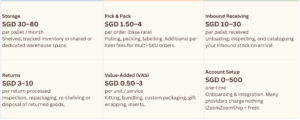
What Are the Main 3PL Cost Components?
Think of your 3PL bill like a utility invoice — there’s a base component for holding your inventory, and a usage component for every order you send through. Here’s what each line item actually means:
1. Storage Fees
This is the rent you pay for your inventory to live in the warehouse. Most Singapore 3PLs charge by the pallet per month — a standard pallet being roughly 1.2m × 1m up to about 1.5m high. Some charge by cubic metre instead, which can work in your favour for dense, compact products.
Expect to pay SGD 30–80 per pallet per month in Singapore. The range is wide because it depends on warehouse location (Jurong vs. Changi), shared vs. dedicated space, and whether temperature control is required.
2. Pick & Pack Fees
Every order triggers a walk of the warehouse floor to pull items, pack them, and label them. Most 3PLs charge a base rate per order (SGD 1.50–4) plus a per-item fee for multi-SKU orders (SGD 0.20–0.80 per additional item). Build this into your margin calculations for multi-SKU bundles.
3. Inbound Receiving
When your supplier ships stock to the 3PL warehouse, someone unloads, checks against your PO, scans into the WMS, and shelves it. Typically SGD 10–30 per pallet or SGD 0.20–0.50 per carton for loose carton receiving.
4. Outbound Shipping (Carrier Costs)
The most variable line on any 3PL invoice. Carrier rates depend on parcel weight, dimensions, destination, and service level. Your 3PL passes carrier rates through — at face value, or with a slight markup. Always ask whether carrier rates are passed through at cost.
5. Returns Processing
Returns happen. The 3PL receives the item back, inspects it, and re-shelves, quarantines, or disposes of it per your instructions. Budget SGD 3–10 per return depending on complexity.
6. Value-Added Services (VAS)
Custom branded packaging, kitting, gift wrapping, insert cards, quality inspection — each adds per-unit cost. If these are central to your brand, get a specific VAS quote from every provider you evaluate.
What Factors Drive Your 3PL Bill Up (or Down)?
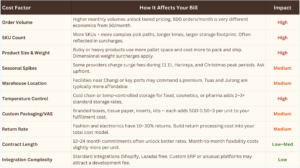
Real Cost Examples for 3 Business Sizes
Theory is useful. Numbers are better. Here are three worked examples based on typical Singapore e-commerce business profiles — all excluding outbound shipping carrier costs, which vary by destination and parcel size.
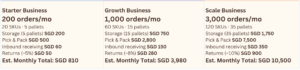
- After-hours or weekend handling — some providers add a surcharge
- Long-term storage surcharge — inventory sitting 90+ days may attract additional fees
- Insurance on stored inventory — typically arranged separately or as a rider
What’s Actually Included and What Isn’t
Typically Included (in standard fees)
✓ Standard pick & pack using your supplied packaging materials
✓ Inbound receiving and basic inspection
✓ Barcode / SKU scanning and inventory tracking in WMS
✓ Client WMS portal access — real-time stock and order dashboards
✓ Standard platform integrations (Shopify, Lazada, Shopee, WooCommerce)
✓ Carrier handoff and basic tracking number generation
Typically Charged Separately
• Outbound shipping carrier costs — always billed separately at carrier rates
• Custom / branded packaging materials — you supply the boxes or pay for branded stock at cost
• Kitting and bundling — assembling product sets or subscription boxes
• Returns shipping labels — charged per return processed
• After-hours or weekend handling — some providers add a surcharge
• Long-term storage surcharge — inventory sitting 90+ days may attract additional fees
• Insurance on stored inventory — typically arranged separately or as a rider
The Hidden Fees Nobody Warns You About
The 3PL industry has a few pricing habits that are, at best, annoying and at worst, genuinely costly. Here are the ones to watch for:
- Minimum monthly spend. Some providers require SGD 800+/month regardless of actual volume. Slow month? You pay anyway. Always ask: ‘Is there a minimum monthly fee?’
- Long-term storage fees. Extra charges for inventory that hasn’t turned over in 60–90 days. Slow-moving seasonal stock quietly balloons your storage bill. Check the trigger window in the contract.
- Carrier markup. Some 3PLs mark up carrier rates by 10–20% without disclosing it. Ask explicitly: ‘Are shipping costs passed through at your carrier rate, or is there a markup?’
- Fuel and peak surcharges. Carriers pass these to 3PLs, who pass them to you. Can spike significantly during festive seasons — build into your peak cost model.
- Account inactivity fees. Going quiet for a month between restocks? Some providers charge for accounts below a minimum order threshold.
- Cancellation / exit fees. Some contracts require 30–90 days’ notice with continued billing, plus retrieval fees for getting your stock out. Read the exit clause before signing.
- Per-SKU onboarding fees. A few providers charge a per-SKU cataloguing fee for large catalogues. Can add up fast if you have 100+ SKUs.
How to Compare 3PL Quotes Without Getting Burned
Comparing 3PL quotes is notoriously difficult because providers structure pricing differently. One quotes by CBM, another by pallet. One bundles inbound receiving, another charges separately. The only way to cut through it cleanly is to use a blended cost per order as your benchmark.
The Blended Cost Formula
Total monthly bill ÷ monthly order volume = blended cost per order. This single number normalises all providers to the same metric. If Provider A quotes SGD 4,200/month for 1,000 orders = SGD 4.20/order. Provider B quotes SGD 3,800 but has a SGD 600/month minimum — your effective floor is higher.
Questions to Ask Every Provider
- Is there a minimum monthly spend or minimum order volume?
- Are carrier shipping rates passed through at cost, or is there a markup?
- What are your long-term storage trigger dates and rates?
- What is the daily order cut-off time for same-day dispatch?
- What is your guaranteed pick accuracy rate and error resolution process?
- What integrations are included, and are there fees for custom ERP connections?
- What are the contract terms, minimum notice period, and exit conditions?
- What does your SLA look like during peak seasons (11.11, Hariraya, Christmas)?
Get Your Custom 3PL Cost Estimate
Tell us your order volume, SKU count, and product type — and we’ll give you a precise, line-by-line cost breakdown. No generic estimates. No hidden fees revealed later.
Frequently Asked Questions
How much does 3PL warehousing cost per month in Singapore?
For most small-to-mid-sized businesses (200 to 1,000 orders per month), 3PL warehousing costs range from SGD 800 to SGD 5,000 per month, excluding outbound shipping. Costs vary based on volume, SKU count, product size, and value-added services like kitting or custom packaging.
What is the average pick and pack cost in Singapore?
Pick and pack fees typically range from SGD 1.50 to SGD 4.00 per order for the base rate, with an additional SGD 0.20 to SGD 0.80 per extra item in the same order. Higher volumes usually unlock better pricing.
Is there a minimum volume requirement for 3PL in Singapore?
Some providers require 300 to 500 orders per month or a minimum monthly spend of SGD 500 to 1,000. Others, like ZoomZoomShip, have no minimum commitment and charge based on actual usage.
Does 3PL pricing include shipping costs?
No. Shipping costs are usually charged separately and passed through at carrier rates, sometimes with a markup. Always clarify how shipping fees are structured before signing.
How does 3PL storage pricing work in Singapore?
Storage is typically charged per pallet (around SGD 30 to 80 per month) or by cubic metre. Some providers apply long-term storage surcharges if inventory remains unsold for 60 to 90 days.
Can I negotiate 3PL pricing in Singapore?
Yes. Pricing is often negotiable, especially if you can commit to higher order volumes. Storage rates and pick and pack fees are the most flexible areas.
What’s cheaper — 3PL or my own warehouse in Singapore?
For most businesses shipping under 5,000 orders per month, 3PL is significantly cheaper once you factor in lease, staff, equipment, WMS, and utilities.