


 0
0

By ZoomZoomShip Editorial Team | Updated April 2026 | 12 min read
If your business is scaling and fast, there comes a point where managing your own warehouse stops making sense. Leasing space, hiring staff, managing inventory software, packing orders at midnight before a sale spike… it all adds up. That’s exactly where 3PL Warehousing Services comes in.
This guide explains everything Singapore business owners need to know about 3PL: what it means, how it works, what it costs, and how to pick the right partner for your supply chain.
TABLE OF CONTENTS
- What Is a 3PL Warehouse?
- How Does 3PL Warehousing Work?
- Who Needs a 3PL Warehouse?
- 3PL vs. In-House Warehousing: What’s the Difference?
- Why Is Singapore a Top 3PL Hub in Asia?
- How Much Does 3PL Warehousing Cost in Singapore?
- How to Choose the Right 3PL Provider in Singapore
- Frequently Asked Questions (FAQs)
What Is a 3PL Warehouse?
A 3PL warehouse (Third-Party Logistics warehouse) is a facility operated by an external logistics company that stores your inventory, picks and packs your orders, and ships them to your customers on your behalf. Instead of building your own warehousing infrastructure, you outsource it entirely to a specialist provider.
The ‘PL’ stands for Third-Party Logistics — the third party being the logistics provider sitting between you (the seller) and your customer. The core promise: you focus on growing your business, they handle the physical movement of your goods.
Modern 3PL warehousing providers offer far more than simple storage. Services typically include:
- Receiving & inventory management — goods arrive, are logged, and tracked in real time
- Pick & pack fulfillment — orders are pulled, packed, and labelled accurately
- Same-day or next-day shipping — integrated with SingPost, DHL, FedEx, Ninja Van
- Returns processing — returned goods are inspected and re-shelved or disposed of
- Value-added services — kitting, bundling, custom packaging, and labelling
How Does 3PL Warehousing Work?
3PL warehousing works through a simple cycle: you send inventory to the 3PL facility, they store it, and when a customer places an order, the 3PL automatically picks, packs, and ships it — often within 24 hours. Everything is tracked through a shared software platform (WMS).
Here’s a step-by-step breakdown of the typical 3PL warehousing service process:
- Onboarding & Integration. Your e-commerce platform (Shopify, Lazada, TikTok Shop, WooCommerce) is connected to the 3PL’s Warehouse Management System (WMS) via API.
- Inbound Shipment. You ship stock directly to the 3PL warehouse. The team receives, inspects, and catalogs everything.
- Storage. Goods are shelved in a dedicated or shared zone, tracked with barcodes or RFID.
- Order Trigger. A customer places an order. The WMS automatically generates a pick list in real time.
- Pick, Pack & Ship. Warehouse staff pull items, pack to your brand specs, print shipping labels, and hand off to the carrier.
- Tracking & Reporting. You and your customer receive tracking updates. Live inventory dashboards show stock levels and fulfillment accuracy.
⚡ ZoomZoomShip Tip: The best 3PL providers offer same-day cut-off times as late as 5 PM — orders placed before then ship out that same evening. This is a key differentiator to ask about when comparing providers.
Who Needs a 3PL Warehouse?
3PL warehousing is ideal for e-commerce brands, importers, and product businesses growing beyond their capacity to self-fulfill orders — or that want to enter new markets without local infrastructure. If you’re shipping more than 100–200 orders per month, 3PL often becomes cost-effective.
You’re likely ready for a 3PL if you recognise any of these signs:
- You’re packing orders from your home, office, or rented storage unit
- Delivery times are inconsistent and customer complaints are rising
- You’re missing orders during peak seasons (Hariraya, 11.11, Christmas)
- You want to sell on regional marketplaces but lack local inventory
- Cash is tied up in warehouse leases and staff that don’t scale with sales
- You’re expanding regionally and need a Singapore hub for ASEAN distribution
Industries commonly using 3PL in Singapore: fashion & apparel, health & wellness, electronics accessories, FMCG brands, and B2B industrial suppliers.
3PL vs. In-House Warehousing: What’s the Difference?
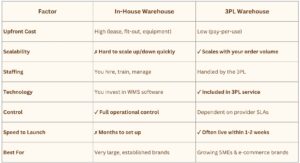
In-house warehousing means you own or lease the space and manage all operations yourself. 3PL means outsourcing storage and fulfillment to a specialist. The key trade-off: control vs. cost and flexibility — 3PL wins on scalability; in-house wins if you need deep process customisation.
Why Is Singapore a Top 3PL Hub in Asia?
Singapore is one of the world’s premier logistics hubs due to its world-class port infrastructure, strategic location at the heart of Southeast Asia, pro-business regulatory environment, and free trade agreements with 27+ countries. For ASEAN-targeting businesses, Singapore-based 3PL warehousing offers unmatched reach.
- Port of Singapore — consistently ranked among the world’s busiest container ports, with connections to 600+ ports globally
- Changi Airport — a top-5 global air freight hub enabling fast cross-border deliveries across Asia
- FTAs with 27+ partners — reduced tariffs when shipping to key ASEAN markets: Malaysia, Indonesia, Thailand, Vietnam
- Advanced logistics infrastructure — modern warehouse parks in Jurong, Tuas, and Woodlands with cold chain and bonded storage options
For D2C brands targeting Southeast Asian consumers, a 3PL warehouse in Singapore cuts delivery times from 7–14 days (international shipping) to 1–3 days (local courier). That’s a conversion-rate game-changer.
How Much Does 3PL Warehousing Cost in Singapore?
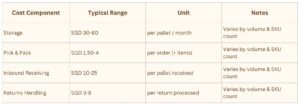
3PL costs in Singapore typically include a storage fee (per pallet/cbm per month), a fulfillment fee per order, and inbound receiving fees. For most SMEs, total 3PL costs run between SGD 2–6 per order fulfilled, depending on package size and value-added services required.
What affects your total cost?
- Order volume — most providers offer tiered pricing; the more you ship, the lower your per-order cost
- SKU count — more SKUs mean more complex inventory management, which can raise fees
- Product dimensions & weight — larger, heavier items use more storage and cost more to pack
- Value-added services — custom branded packaging, kitting, or fragile handling add to costs
💡 Pro Tip: Always ask for a blended cost per order estimate from any 3PL — not just their individual line-item rates. A provider with a low pick fee but high storage fees could cost more than a competitor with simpler bundled pricing.
How to Choose the Right 3PL Provider in Singapore
To choose the right 3PL in Singapore, evaluate providers on their technology integrations, fulfillment speed (same-day or next-day SLAs), pricing transparency, minimum commitment requirements, and track record with businesses at your scale and in your product category.
Practical checklist for evaluating Singapore 3PL providers:
- Platform integrations: Connects natively with Shopify, Lazada, Shopee, WooCommerce, TikTok Shop?
- Fulfillment SLAs: What’s the daily order cut-off? What’s pick accuracy? (Target: 99%+)
- Inventory visibility: Real-time stock dashboards? Low-stock alerts? Automated reorder triggers?
- Carrier network: Which last-mile carriers do they work with? Can you choose per route?
- Minimum commitments: Is there a minimum order volume or monthly spend? Avoid punishing minimums.
- Returns management: How are returns and damaged goods handled? What’s the inspection process?
- Scalability: Can they handle a 5x spike during peak season without degrading service?
- Onboarding time: How quickly can you go live? Good 3PLs onboard within 5–10 business days.
- Transparent pricing: All fees disclosed upfront, no hidden surcharges?
- Customer support: Dedicated account manager, or just a generic helpdesk?
At ZoomZoomShip’s 3PL warehousing service, we offer same-day fulfillment, native integrations with Shopify, Lazada, TikTok Shop and more, and zero minimum order commitments — so you can scale on your terms.
Ready to Outsource Your Warehousing?
ZoomZoomShip’s Singapore 3PL service offers same-day fulfillment, zero minimums, and seamless integrations with your store — so you can focus on growing, not packing boxes.
→ Get a Free Quote ←
Frequently Asked Questions
What is the difference between 3PL and 4PL?
A 3PL handles storage, fulfillment, and shipping. A 4PL manages your entire supply chain strategy and coordinates multiple logistics partners.
Is 3PL warehousing suitable for small businesses in Singapore?
Yes. Many 3PL providers support SMEs with flexible terms and low or no minimum order volumes. If you are shipping around 50 to 100 orders per month, outsourcing can save time and improve delivery consistency.
How long does it take to set up a 3PL arrangement in Singapore?
Most providers can onboard within 5 to 14 business days, including integration, SKU setup, and inbound shipment handling.
Can a 3PL in Singapore handle cross-border shipping to ASEAN?
Yes. Singapore-based 3PLs are well-positioned for ASEAN distribution and typically support customs documentation and regional courier coordination.
What is a WMS, and do I need one if I use a 3PL?
A WMS tracks inventory and fulfillment. With a 3PL, access is usually included via a client dashboard, so you do not need your own system.
What happens to my inventory if my 3PL provider shuts down?
Review insurance coverage and contract terms before signing. A reliable provider will outline stock protection and retrieval processes clearly.
Does ZoomZoomShip offer 3PL warehousing for marketplace sellers?
Yes. ZoomZoomShip integrates with major marketplaces, allowing automated syncing, fulfillment, and tracking updates.