


 0
0
How Much Does 3PL Warehousing Cost in Singapore? (2026 Pricing Guide)

By ZoomZoomShip Editorial Team | Updated March 2026 | 13 min read

Here’s a frustrating truth about the 3PL industry: most providers treat pricing like a state secret. You fill out a contact form, wait three business days, hop on a call, and eventually — maybe — someone gives you a number.
We think that’s a waste of your time. So this guide gives you real 2026 numbers for 3PL warehousing costs in Singapore — what each component costs, what drives the bill up or down, and how to evaluate a quote without getting stung by fees buried in the fine print.
Let’s get into it.
TABLE OF CONTENTS
1. The TL;DR — Cost Summary at a Glance
2. What Are the Main 3PL Cost Components?
3. What Factors Drive Your 3PL Bill Up (or Down)?
4. Real Cost Examples for 3 Business Sizes
5. What’s Actually Included — and What Isn’t
6. The Hidden Fees Nobody Warns You About
7. How to Compare 3PL Quotes Without Getting Burned
8. Frequently Asked Questions (FAQ)
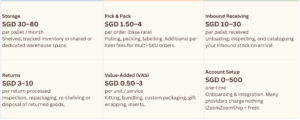
The TL;DR — Cost Summary at a Glance
What Are the Main 3PL Cost Components?
Think of your 3PL bill like a utility invoice — there’s a base component for holding your inventory, and a usage component for every order you send through. Here’s what each line item actually means:
1. Storage Fees
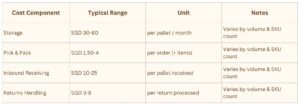
This is the rent you pay for your inventory to live in the warehouse. Most Singapore 3PLs charge by the pallet per month — a standard pallet being roughly 1.2m × 1m up to about 1.5m high. Some charge by cubic metre instead, which can work in your favour for dense, compact products.
Expect to pay SGD 30–80 per pallet per month in Singapore. The range is wide because it depends on warehouse location (Jurong vs. Changi), shared vs. dedicated space, and whether temperature control is required.
2. Pick & Pack Fees
Every order triggers a walk of the warehouse floor to pull items, pack them, and label them. Most 3PLs charge a base rate per order (SGD 1.50–4) plus a per-item fee for multi-SKU orders (SGD 0.20–0.80 per additional item). Build this into your margin calculations for multi-SKU bundles.
3. Inbound Receiving
When your supplier ships stock to the 3PL warehouse, someone unloads, checks against your PO, scans into the WMS, and shelves it. Typically SGD 10–30 per pallet or SGD 0.20–0.50 per carton for loose carton receiving.
4. Outbound Shipping (Carrier Costs)
The most variable line on any 3PL invoice. Carrier rates depend on parcel weight, dimensions, destination, and service level. Your 3PL passes carrier rates through — at face value, or with a slight markup. Always ask whether carrier rates are passed through at cost.
5. Returns Processing
Returns happen. The 3PL receives the item back, inspects it, and re-shelves, quarantines, or disposes of it per your instructions. Budget SGD 3–10 per return depending on complexity.
6. Value-Added Services (VAS)
Custom branded packaging, kitting, gift wrapping, insert cards, quality inspection — each adds per-unit cost. If these are central to your brand, get a specific VAS quote from every provider you evaluate.
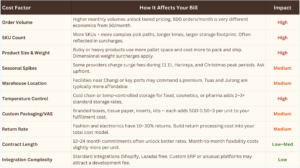
What Factors Drive Your 3PL Bill Up (or Down)?
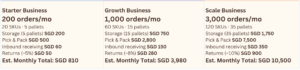
Real Cost Examples for 3 Business Sizes
Theory is useful. Numbers are better. Here are three worked examples based on typical Singapore e-commerce business profiles — all excluding outbound shipping carrier costs, which vary by destination and parcel size.
- After-hours or weekend handling — some providers add a surcharge
- Long-term storage surcharge — inventory sitting 90+ days may attract additional fees
- Insurance on stored inventory — typically arranged separately or as a rider
What’s Actually Included and What Isn’t
Typically Included (in standard fees)
✓ Standard pick & pack using your supplied packaging materials
✓ Inbound receiving and basic inspection
✓ Barcode / SKU scanning and inventory tracking in WMS
✓ Client WMS portal access — real-time stock and order dashboards
✓ Standard platform integrations (Shopify, Lazada, Shopee, WooCommerce)
✓ Carrier handoff and basic tracking number generation
Typically Charged Separately
• Outbound shipping carrier costs — always billed separately at carrier rates
• Custom / branded packaging materials — you supply the boxes or pay for branded stock at cost
• Kitting and bundling — assembling product sets or subscription boxes
• Returns shipping labels — charged per return processed
• After-hours or weekend handling — some providers add a surcharge
• Long-term storage surcharge — inventory sitting 90+ days may attract additional fees
• Insurance on stored inventory — typically arranged separately or as a rider
The Hidden Fees Nobody Warns You About
The 3PL industry has a few pricing habits that are, at best, annoying and at worst, genuinely costly. Here are the ones to watch for:
- Minimum monthly spend. Some providers require SGD 800+/month regardless of actual volume. Slow month? You pay anyway. Always ask: ‘Is there a minimum monthly fee?’
- Long-term storage fees. Extra charges for inventory that hasn’t turned over in 60–90 days. Slow-moving seasonal stock quietly balloons your storage bill. Check the trigger window in the contract.
- Carrier markup. Some 3PLs mark up carrier rates by 10–20% without disclosing it. Ask explicitly: ‘Are shipping costs passed through at your carrier rate, or is there a markup?’
- Fuel and peak surcharges. Carriers pass these to 3PLs, who pass them to you. Can spike significantly during festive seasons — build into your peak cost model.
- Account inactivity fees. Going quiet for a month between restocks? Some providers charge for accounts below a minimum order threshold.
- Cancellation / exit fees. Some contracts require 30–90 days’ notice with continued billing, plus retrieval fees for getting your stock out. Read the exit clause before signing.
- Per-SKU onboarding fees. A few providers charge a per-SKU cataloguing fee for large catalogues. Can add up fast if you have 100+ SKUs.
How to Compare 3PL Quotes Without Getting Burned
Comparing 3PL quotes is notoriously difficult because providers structure pricing differently. One quotes by CBM, another by pallet. One bundles inbound receiving, another charges separately. The only way to cut through it cleanly is to use a blended cost per order as your benchmark.
The Blended Cost Formula
Total monthly bill ÷ monthly order volume = blended cost per order. This single number normalises all providers to the same metric. If Provider A quotes SGD 4,200/month for 1,000 orders = SGD 4.20/order. Provider B quotes SGD 3,800 but has a SGD 600/month minimum — your effective floor is higher.
Questions to Ask Every Provider
- Is there a minimum monthly spend or minimum order volume?
- Are carrier shipping rates passed through at cost, or is there a markup?
- What are your long-term storage trigger dates and rates?
- What is the daily order cut-off time for same-day dispatch?
- What is your guaranteed pick accuracy rate and error resolution process?
- What integrations are included, and are there fees for custom ERP connections?
- What are the contract terms, minimum notice period, and exit conditions?
- What does your SLA look like during peak seasons (11.11, Hariraya, Christmas)?
Get Your Custom 3PL Cost Estimate
Tell us your order volume, SKU count, and product type — and we’ll give you a precise, line-by-line cost breakdown. No generic estimates. No hidden fees revealed later.
Frequently Asked Questions
How much does 3PL warehousing cost per month in Singapore?
For most small-to-mid-sized businesses (200 to 1,000 orders per month), 3PL warehousing costs range from SGD 800 to SGD 5,000 per month, excluding outbound shipping. Costs vary based on volume, SKU count, product size, and value-added services like kitting or custom packaging.
What is the average pick and pack cost in Singapore?
Pick and pack fees typically range from SGD 1.50 to SGD 4.00 per order for the base rate, with an additional SGD 0.20 to SGD 0.80 per extra item in the same order. Higher volumes usually unlock better pricing.
Is there a minimum volume requirement for 3PL in Singapore?
Some providers require 300 to 500 orders per month or a minimum monthly spend of SGD 500 to 1,000. Others, like ZoomZoomShip, have no minimum commitment and charge based on actual usage.
Does 3PL pricing include shipping costs?
No. Shipping costs are usually charged separately and passed through at carrier rates, sometimes with a markup. Always clarify how shipping fees are structured before signing.
How does 3PL storage pricing work in Singapore?
Storage is typically charged per pallet (around SGD 30 to 80 per month) or by cubic metre. Some providers apply long-term storage surcharges if inventory remains unsold for 60 to 90 days.
Can I negotiate 3PL pricing in Singapore?
Yes. Pricing is often negotiable, especially if you can commit to higher order volumes. Storage rates and pick and pack fees are the most flexible areas.
What’s cheaper — 3PL or my own warehouse in Singapore?
For most businesses shipping under 5,000 orders per month, 3PL is significantly cheaper once you factor in lease, staff, equipment, WMS, and utilities.
3PL vs In-House Warehousing: Which is Right for Your Business in Singapore?

By ZoomZoomShip Editorial Team | Updated March 2026 | 14 min read
Here’s the situation a lot of Singapore business owners find themselves in: you started packing orders from your HDB or office pantry. Then you rented a small storage unit. Now things are getting serious — your team is exhausted, SLAs are slipping, and someone suggested you look into a 3PL Warehousing Fulfilment in Singapore.
So you Googled it. And now you’re here, weighing up whether to sign a warehouse lease or hand your inventory to someone else entirely.
Good news: this is actually one of the easier business decisions to reason through — once you have the right framework. Let’s walk through it properly.
Table of Contents:
1. What’s the Difference Between 3PL and In-House Warehousing?
2. The Real Cost Comparison (No Sugarcoating)
3. Pros and Cons of Each — Honestly
4. Who Wins in Each Scenario?
5. The Verdict: Which Should You Choose?
6. When Should You Switch from In-House to 3PL?
7. Frequently Asked Questions (FAQ)
What’s the Difference Between 3PL and In-House Warehousing?
Think of it this way. In-house is like buying a car — you own it, you maintain it, and it’s there even on days you don’t drive. 3PL is like a really reliable Grab driver who always shows up, scales with how often you need rides, and sends you a clean invoice at the end of the month.
Neither is universally ‘better.’ The right answer depends entirely on your order volume, growth stage, product type, and how much operational complexity you actually want to own. That’s what the rest of this guide unpacks.
The Real Cost Comparison (No Sugarcoating)
One of the biggest mistakes businesses make when evaluating this is comparing headline numbers — ‘my warehouse costs SGD 4,000/month’ — without accounting for the full cost stack. Let’s put both options on the table properly.
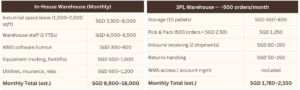
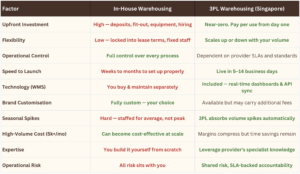
The math starts to shift as you scale. At very high order volumes (5,000+ orders/month), in-house can become cost-competitive — but by then you’re also looking at enterprise-level operational complexity. For most Singapore SMEs shipping under 3,000 orders a month, 3PL almost always wins on total cost.
Pros and Cons of Each — Honestly
We’ll be straight with you — most 3PL providers would write this section with a heavy thumb on the scale. We’re going to try not to do that. Here’s an honest look at both:
Who Wins in Each Scenario?
The Verdict: Which Should You Choose
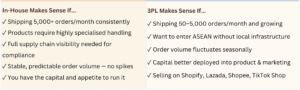
Here’s a fast decision framework. Answer these five questions honestly:
The 5-Question Decision Framework
[3PL] Do you ship fewer than 5,000 orders per month? If yes, 3PL almost certainly wins on cost.
[3PL] Is your volume seasonal or unpredictable? 3PL absorbs the spikes. In-house makes you overstaff for peaks.
[IN-HOUSE] Do you have highly unusual handling requirements that no 3PL in Singapore can match? In-house may be your only option.
[3PL] Are you expanding into new markets (Malaysia, Indonesia, Philippines)? A Singapore 3PL hub gets you there in days, not months.
[3PL] Would that warehouse capital be better deployed into marketing, inventory, or product? Almost always yes in early growth stages.
If you answered mostly orange: ZoomZoomShip’s 3PL warehousing service is worth a conversation. If you answered mostly blue: you’re at a scale where in-house may genuinely make sense — and we’d still recommend a 3PL cost comparison before signing a lease.
When Should You Switch from In-House to 3PL?
Sometimes the ‘which is better’ question is actually ‘we’re already in-house — when do we know it’s time to move?’ These are the clearest signals:
• Your error rate is creeping up. Mis-picks, wrong addresses, late dispatches — symptoms of a fulfilment operation running near its ceiling.
• You’re dreading every peak season. If 11.11 or Hariraya fills you with dread rather than excitement, your warehousing setup is costing you revenue.
• Your lease is up for renewal. This is the natural moment to re-evaluate. A 3-year renewal is a long commitment — at least get a 3PL quote before you sign.
• You want to sell regionally but can’t fulfil regionally. A Singapore 3PL warehouse changes this overnight via Lazada, Shopee, and regional carriers.
• Your team spends more time packing than growing. If talented people are doing repetitive manual tasks, you’re misallocating your most expensive resource.
Still on the Fence? Let’s Run the Numbers Together.
Tell us your monthly order volume and current setup — we’ll give you a straight cost comparison. No hard sell. No obligation. Just clarity.
Frequently Asked Questions
Is 3PL cheaper than in-house warehousing in Singapore?
For most businesses shipping under 5,000 orders per month, yes. 3PL is usually cheaper once you account for lease, staff, WMS, equipment, utilities, and management time. Singapore’s high industrial real estate costs make this especially noticeable.
Can I use a 3PL in Singapore just for overflow during peak season?
Yes. Many businesses use 3PL as overflow support during peak periods like 11.11, Hariraya, or Christmas. It’s often a stepping stone before moving to full 3PL.
What’s the minimum order volume to make 3PL worthwhile in Singapore?
Most 3PL providers become cost-effective at around 100 to 200 orders per month. Below that, time savings may still justify outsourcing.
Will I lose control of my brand if I use a 3PL?
No — a good 3PL follows your packing instructions, uses branded packaging, and maintains your customer experience.
How quickly can I switch from in-house to a 3PL in Singapore?
Most transitions take 2 to 4 weeks, including integration, stock transfer, and testing.
What happens if my 3PL makes a fulfillment error?
A reliable 3PL will have SLAs covering accuracy, dispatch times, and error resolution. Always review this before signing.
Does ZoomZoomShip offer both 3PL and freight forwarding?
Yes. ZoomZoomShip handles freight forwarding, customs clearance, warehousing, fulfillment, and last-mile delivery.
What Is 3PL Warehousing? A Complete Guide for Singapore Businesses

By ZoomZoomShip Editorial Team | Updated April 2026 | 12 min read
If your business is scaling and fast, there comes a point where managing your own warehouse stops making sense. Leasing space, hiring staff, managing inventory software, packing orders at midnight before a sale spike… it all adds up. That’s exactly where 3PL Warehousing Services comes in.
This guide explains everything Singapore business owners need to know about 3PL: what it means, how it works, what it costs, and how to pick the right partner for your supply chain.
TABLE OF CONTENTS
- What Is a 3PL Warehouse?
- How Does 3PL Warehousing Work?
- Who Needs a 3PL Warehouse?
- 3PL vs. In-House Warehousing: What’s the Difference?
- Why Is Singapore a Top 3PL Hub in Asia?
- How Much Does 3PL Warehousing Cost in Singapore?
- How to Choose the Right 3PL Provider in Singapore
- Frequently Asked Questions (FAQs)
What Is a 3PL Warehouse?
A 3PL warehouse (Third-Party Logistics warehouse) is a facility operated by an external logistics company that stores your inventory, picks and packs your orders, and ships them to your customers on your behalf. Instead of building your own warehousing infrastructure, you outsource it entirely to a specialist provider.
The ‘PL’ stands for Third-Party Logistics — the third party being the logistics provider sitting between you (the seller) and your customer. The core promise: you focus on growing your business, they handle the physical movement of your goods.
Modern 3PL warehousing providers offer far more than simple storage. Services typically include:
- Receiving & inventory management — goods arrive, are logged, and tracked in real time
- Pick & pack fulfillment — orders are pulled, packed, and labelled accurately
- Same-day or next-day shipping — integrated with SingPost, DHL, FedEx, Ninja Van
- Returns processing — returned goods are inspected and re-shelved or disposed of
- Value-added services — kitting, bundling, custom packaging, and labelling
How Does 3PL Warehousing Work?
3PL warehousing works through a simple cycle: you send inventory to the 3PL facility, they store it, and when a customer places an order, the 3PL automatically picks, packs, and ships it — often within 24 hours. Everything is tracked through a shared software platform (WMS).
Here’s a step-by-step breakdown of the typical 3PL warehousing service process:
- Onboarding & Integration. Your e-commerce platform (Shopify, Lazada, TikTok Shop, WooCommerce) is connected to the 3PL’s Warehouse Management System (WMS) via API.
- Inbound Shipment. You ship stock directly to the 3PL warehouse. The team receives, inspects, and catalogs everything.
- Storage. Goods are shelved in a dedicated or shared zone, tracked with barcodes or RFID.
- Order Trigger. A customer places an order. The WMS automatically generates a pick list in real time.
- Pick, Pack & Ship. Warehouse staff pull items, pack to your brand specs, print shipping labels, and hand off to the carrier.
- Tracking & Reporting. You and your customer receive tracking updates. Live inventory dashboards show stock levels and fulfillment accuracy.
⚡ ZoomZoomShip Tip: The best 3PL providers offer same-day cut-off times as late as 5 PM — orders placed before then ship out that same evening. This is a key differentiator to ask about when comparing providers.
Who Needs a 3PL Warehouse?
3PL warehousing is ideal for e-commerce brands, importers, and product businesses growing beyond their capacity to self-fulfill orders — or that want to enter new markets without local infrastructure. If you’re shipping more than 100–200 orders per month, 3PL often becomes cost-effective.
You’re likely ready for a 3PL if you recognise any of these signs:
- You’re packing orders from your home, office, or rented storage unit
- Delivery times are inconsistent and customer complaints are rising
- You’re missing orders during peak seasons (Hariraya, 11.11, Christmas)
- You want to sell on regional marketplaces but lack local inventory
- Cash is tied up in warehouse leases and staff that don’t scale with sales
- You’re expanding regionally and need a Singapore hub for ASEAN distribution
Industries commonly using 3PL in Singapore: fashion & apparel, health & wellness, electronics accessories, FMCG brands, and B2B industrial suppliers.
3PL vs. In-House Warehousing: What’s the Difference?
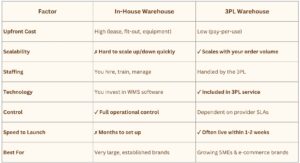
In-house warehousing means you own or lease the space and manage all operations yourself. 3PL means outsourcing storage and fulfillment to a specialist. The key trade-off: control vs. cost and flexibility — 3PL wins on scalability; in-house wins if you need deep process customisation.
Why Is Singapore a Top 3PL Hub in Asia?
Singapore is one of the world’s premier logistics hubs due to its world-class port infrastructure, strategic location at the heart of Southeast Asia, pro-business regulatory environment, and free trade agreements with 27+ countries. For ASEAN-targeting businesses, Singapore-based 3PL warehousing offers unmatched reach.
- Port of Singapore — consistently ranked among the world’s busiest container ports, with connections to 600+ ports globally
- Changi Airport — a top-5 global air freight hub enabling fast cross-border deliveries across Asia
- FTAs with 27+ partners — reduced tariffs when shipping to key ASEAN markets: Malaysia, Indonesia, Thailand, Vietnam
- Advanced logistics infrastructure — modern warehouse parks in Jurong, Tuas, and Woodlands with cold chain and bonded storage options
For D2C brands targeting Southeast Asian consumers, a 3PL warehouse in Singapore cuts delivery times from 7–14 days (international shipping) to 1–3 days (local courier). That’s a conversion-rate game-changer.
How Much Does 3PL Warehousing Cost in Singapore?
3PL costs in Singapore typically include a storage fee (per pallet/cbm per month), a fulfillment fee per order, and inbound receiving fees. For most SMEs, total 3PL costs run between SGD 2–6 per order fulfilled, depending on package size and value-added services required.
What affects your total cost?
- Order volume — most providers offer tiered pricing; the more you ship, the lower your per-order cost
- SKU count — more SKUs mean more complex inventory management, which can raise fees
- Product dimensions & weight — larger, heavier items use more storage and cost more to pack
- Value-added services — custom branded packaging, kitting, or fragile handling add to costs
💡 Pro Tip: Always ask for a blended cost per order estimate from any 3PL — not just their individual line-item rates. A provider with a low pick fee but high storage fees could cost more than a competitor with simpler bundled pricing.
How to Choose the Right 3PL Provider in Singapore
To choose the right 3PL in Singapore, evaluate providers on their technology integrations, fulfillment speed (same-day or next-day SLAs), pricing transparency, minimum commitment requirements, and track record with businesses at your scale and in your product category.
Practical checklist for evaluating Singapore 3PL providers:
- Platform integrations: Connects natively with Shopify, Lazada, Shopee, WooCommerce, TikTok Shop?
- Fulfillment SLAs: What’s the daily order cut-off? What’s pick accuracy? (Target: 99%+)
- Inventory visibility: Real-time stock dashboards? Low-stock alerts? Automated reorder triggers?
- Carrier network: Which last-mile carriers do they work with? Can you choose per route?
- Minimum commitments: Is there a minimum order volume or monthly spend? Avoid punishing minimums.
- Returns management: How are returns and damaged goods handled? What’s the inspection process?
- Scalability: Can they handle a 5x spike during peak season without degrading service?
- Onboarding time: How quickly can you go live? Good 3PLs onboard within 5–10 business days.
- Transparent pricing: All fees disclosed upfront, no hidden surcharges?
- Customer support: Dedicated account manager, or just a generic helpdesk?
At ZoomZoomShip’s 3PL warehousing service, we offer same-day fulfillment, native integrations with Shopify, Lazada, TikTok Shop and more, and zero minimum order commitments — so you can scale on your terms.
Ready to Outsource Your Warehousing?
ZoomZoomShip’s Singapore 3PL service offers same-day fulfillment, zero minimums, and seamless integrations with your store — so you can focus on growing, not packing boxes.
→ Get a Free Quote ←
Frequently Asked Questions
What is the difference between 3PL and 4PL?
A 3PL handles storage, fulfillment, and shipping. A 4PL manages your entire supply chain strategy and coordinates multiple logistics partners.
Is 3PL warehousing suitable for small businesses in Singapore?
Yes. Many 3PL providers support SMEs with flexible terms and low or no minimum order volumes. If you are shipping around 50 to 100 orders per month, outsourcing can save time and improve delivery consistency.
How long does it take to set up a 3PL arrangement in Singapore?
Most providers can onboard within 5 to 14 business days, including integration, SKU setup, and inbound shipment handling.
Can a 3PL in Singapore handle cross-border shipping to ASEAN?
Yes. Singapore-based 3PLs are well-positioned for ASEAN distribution and typically support customs documentation and regional courier coordination.
What is a WMS, and do I need one if I use a 3PL?
A WMS tracks inventory and fulfillment. With a 3PL, access is usually included via a client dashboard, so you do not need your own system.
What happens to my inventory if my 3PL provider shuts down?
Review insurance coverage and contract terms before signing. A reliable provider will outline stock protection and retrieval processes clearly.
Does ZoomZoomShip offer 3PL warehousing for marketplace sellers?
Yes. ZoomZoomShip integrates with major marketplaces, allowing automated syncing, fulfillment, and tracking updates.