


 0
0
Cross-Border Land Transport: Shipping Between Singapore and Malaysia Explained

Everything businesses need to know about moving goods across the Causeway and Second Link — FTL vs LTL, customs documents, transit times, and the pitfalls to avoid.
TABLE OF CONTENTS
- Why the Singapore-Malaysia Corridor is Unique
- FTL vs LTL: Choosing the Right Shipping Mode
- Custom Document Required for Singapore-Malaysia Land Shipments
- Typical Transit Times: What to Realistically Expect
- Common Pitfalls and How to Avoid Them
- What to Look For in a Cross Border Logistics Company
- How ZoomZoomShip Handles Singapore-Malaysia Cross-Border Shipping
Why the Singapore–Malaysia Corridor Is Unique
The land border between Singapore and Malaysia is unlike any other in Southeast Asia. Two crossing points — the Johor-Singapore Causeway in the west and the Tuas Second Link in the east — handle an extraordinary volume of commercial trucks every single day. Despite being neighbouring countries with deep economic ties, cross-border shipments still require proper customs clearance on both sides, the right documentation, and a logistics partner who understands the process inside out.
For businesses, getting this right means faster transit times, fewer delays at checkpoints, and lower costs. Getting it wrong means cargo sitting at the border, demurrage charges mounting, and frustrated customers.
FTL vs LTL: Choosing the Right Shipping Mode
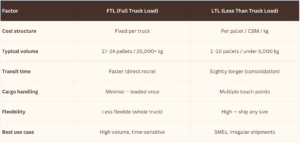
The first decision every shipper needs to make is whether to book a Full Truck Load (FTL) or Less Than Truck Load (LTL) service. The right choice depends on your cargo volume, budget, and how urgently you need delivery.
Full Truck Load (FTL)
With FTL, you book an entire truck exclusively for your cargo — even if it is not completely full. The truck drives directly from origin to destination without stopping to pick up or drop off other shipments.
- Best for: Large shipments that fill or nearly fill a standard truck (typically 17–24 pallets or 20,000–33,000 kg gross weight).
- Advantages: Faster transit, lower risk of damage, greater security, no co-mingling with other cargo.
- Pricing: Fixed rate per truck per trip, regardless of exact cargo weight or volume.
- Ideal for: Time-sensitive goods, high-value cargo, perishables, and businesses with consistent high-volume shipments.
Less Than Truck Load (LTL)
With LTL, your cargo shares truck space with other shippers’ goods. You pay only for the space your shipment occupies, making it cost-effective for smaller volumes.
- Best for: Smaller shipments that do not fill a truck — typically 1–10 pallets or under 5,000 kg.
- Advantages: Lower cost per shipment, no need to wait until you have a full load, flexibility to ship frequently.
- Considerations: Slightly longer transit times due to consolidation, cargo may be handled multiple times.
- Ideal for: SMEs, e-commerce businesses, and companies with irregular or lower-volume cross-border shipping needs.
Not sure which mode fits your shipment? ZoomZoomShip’s team can advise based on your cargo dimensions, weight, and delivery timeline.
Customs Documents Required for Singapore–Malaysia Land Shipments
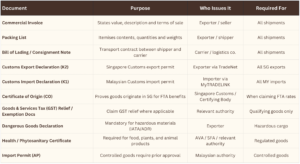
Customs documentation is where most cross-border shipments run into trouble. Missing or incorrect paperwork is the single most common cause of border delays. Below is a comprehensive breakdown of what is required — and why each document matters.
Important:
Singapore’s TradeNet system and Malaysia’s MyTRADELINK portal are the primary channels for submitting customs declarations. A reputable cross-border logistics company will handle these submissions on your behalf — but you must ensure the underlying commercial documents are accurate before handing them over.
Free Trade Agreement (FTA) considerations
The ASEAN Free Trade Area (AFTA) and the Malaysia–Singapore bilateral FTA provide preferential tariff rates on qualifying goods. To benefit, you need a valid Certificate of Origin — either a Form D (for AFTA) or applicable bilateral CO. A qualified freight forwarder or cross-border shipping service provider can help you determine which FTA applies and whether your goods qualify.
Typical Transit Times: What to Realistically Expect
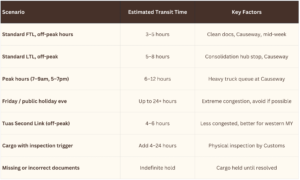
Transit times on the Singapore–Malaysia land corridor vary significantly based on the time of day, day of the week, the crossing point used, and the nature of the cargo. Here is a realistic guide.
Planning tip:
For time-sensitive shipments, book your truck departure for before 6am or after 8pm on weekdays. Tuesdays and Wednesdays typically see the lightest border congestion. Always build in a buffer of at least 4 hours beyond your expected transit time when quoting delivery windows to customers.
Common Pitfalls — and How to Avoid Them
Even experienced shippers encounter problems on this corridor. These are the most frequent issues we see — and what you can do to prevent them.
Incorrect or incomplete customs declarations
Mismatched values between the commercial invoice and the customs declaration are the fastest route to a cargo hold. Ensure your Harmonised System (HS) codes, declared values, and descriptions match precisely across all documents.
Undervaluing goods on the invoice
Attempting to declare a lower value to reduce duties is illegal in both Singapore and Malaysia. Customs on both sides actively cross-reference market values. The penalties — fines, cargo seizure, and potential blacklisting — far outweigh any short-term saving.
Using a carrier not authorised for cross-border
Not every truck operator holds the necessary Goods Vehicle Licence and cross-border permits. Using an unlicensed carrier can result in cargo being turned away at the checkpoint. Always verify your logistics provider’s licensing before booking.
Overlooking controlled or prohibited goods categories
Certain goods require advance import permits in Malaysia — including certain chemicals, pharmaceuticals, electronics, and food products. Arriving at the border without the correct AP is a guaranteed delay. Confirm your product’s classification before shipping.
Failing to account for GST and customs duty liability
Goods imported into Malaysia may attract import duties and Sales and Service Tax (SST). Businesses that have not factored this into their landed cost calculations often receive an unexpected tax bill. Your logistics partner should provide a landed cost estimate in advance.
Last-minute bookings during peak periods
The Causeway becomes extremely congested during Malaysia and Singapore public holidays, school holidays, and year-end periods. Booking a truck with less than 24 hours’ notice during these windows often means paying a premium or missing the window entirely. Plan at least a week ahead during peak seasons.
Red flag to watch:
If a logistics provider quotes you an unusually low price and cannot clearly explain how they handle customs documentation and compliance, walk away. Cheap cross-border shipping that cuts compliance corners can leave you with detained cargo, fines, and no recourse.
What to Look for in a Cross-Border Logistics Company
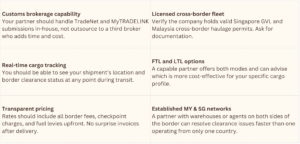
Choosing the right logistics partner for the Singapore–Malaysia corridor is as important as getting your documentation right. Here is what separates reliable cross-border logistics companies from the rest.
How ZoomZoomShip Handles Singapore–Malaysia Cross-Border Shipping
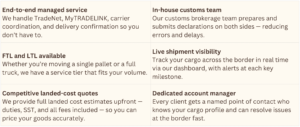
ZoomZoomShip is a Singapore-based cross-border shipping service provider with a dedicated land transport operation between Singapore and Malaysia. We manage the entire journey — from customs declaration and document preparation to truck dispatch and proof of delivery.
What happens if my cargo is held by customs?
If your cargo is flagged for inspection or held due to documentation issues, your logistics provider should be your first call. A partner with an in-house customs team can resolve most issues within hours. Shipments held due to incorrect declarations may require amended documents and, in some cases, payment of penalties before release.
Ship Between Singapore & Malaysia — the Smart Way
ZoomZoomShip specialises in cross-border land transport between Singapore and Malaysia. FTL, LTL, customs handled — all under one roof.
Frequently Asked Questions
Technically no — you can submit declarations yourself through TradeNet and MyTRADELINK. In practice, most businesses use a licensed freight forwarder or customs broker because errors are costly and the process is complex. A qualified cross-border logistics company will handle this as part of their service.
FTL rates are typically quoted per trip (per truck) regardless of cargo weight, while LTL rates are calculated per pallet, per CBM (cubic metre), or per kg — whichever yields the higher charge. Additional fees may include fuel surcharges, border processing fees, chassis fees, and overtime charges for weekend or public holiday crossings.
Yes. Reefer (refrigerated) trucks operate on the Singapore–Malaysia corridor regularly. You will need to ensure cold-chain integrity documentation is in order and that your logistics provider has reefer-capable vehicles. Temperature logs are typically required for food-grade shipments.
Both Singapore and Malaysia maintain lists of prohibited and controlled goods. Common categories include certain chemicals, firearms, endangered species products, and some pharmaceuticals. Your logistics provider should screen your cargo against both countries’ restricted lists before accepting the booking.
The most effective strategies are: consolidating LTL shipments to reach FTL volumes, scheduling shipments during off-peak border hours, ensuring documentation is always complete and accurate (errors are expensive), and working with a logistics partner who has negotiated carrier rates you cannot access independently.