


 0
0
What Is an E-Commerce Fulfilment Centre and Do You Need One

By ZoomZoomShip Team · 10 min read · Fulfilment · Singapore · E-Commerce Operations
TABLE OF CONTENTS
- What is an ECommerce Fulfilment Centre?
- How Does a Fulfilment Centre Work, Step by Step?
- Why Fulfilment Centres Matter in Singapore
- 5 Signs Your Business Needs a Fulfilment Centre Right Now
- Fulfilment Centre vs. In-House vs. 3PL: A Clear Comparison
- How to Choose the Right Fulfilment Centre in Singapore
- How ZoomZoomShip Makes Fulfilment Simple for Singapore Sellers
What is an E-Commerce Fulfilment Centre?
An e-commerce fulfilment centre (also called a fulfilment warehouse or 3PL fulfilment hub) is a specialist facility that stores your inventory and handles the entire order-to-doorstep journey on your behalf — including receiving stock, storing it, picking individual items, packing orders and shipping them to customers.
Unlike a traditional warehouse that simply holds pallets, a fulfilment centre is built for speed and accuracy at the individual order level. Think of it as an outsourced operations team that runs 24/7 so you don’t have to.
Key services a fulfilment centre handles
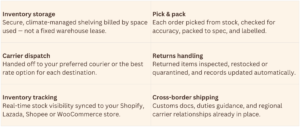
How Does a Fulfilment Centre Work, Step by Step?
The process is simpler than most sellers expect. Here’s what happens from the moment your stock arrives to the moment your customer receives their parcel.
You send stock to the fulfilment centre
Ship your inventory directly from your supplier or your own storage. The centre receives, inspects and books it into your account in the system.
Your store integrates with the fulfilment platform
Orders from Shopify, WooCommerce, Lazada or Shopee flow automatically into the fulfilment management system — no manual CSV uploads.
An order comes in
A warehouse picker receives a digital packing slip, locates the item on the shelf, and brings it to the packing station — typically within minutes.
The order is packed and labelled
Your branded packaging (if you supply it) is used. The shipping label is generated automatically with the correct carrier and service level.
The courier collects the parcel
Carriers collect multiple times daily. Tracking numbers are automatically pushed to your store and emailed to your customer.
Why Fulfilment Centres Matter in Singapore
Singapore’s e-commerce market is one of the most competitive in Southeast Asia. Customers here expect same-day or next-day delivery as a baseline — not a premium. A Singapore-based fulfilment centre gives you the speed, compliance knowledge and regional carrier access to meet that expectation without hiring a logistics team of your own.
There’s also the reality of Singapore’s physical constraints. Most businesses simply cannot afford, or physically find, the warehouse space to store significant inventory. A fulfilment centre in Singapore lets you share infrastructure costs across many merchants while paying only for the space and throughput you actually use.
Finally, Singapore sits at the heart of Southeast Asia’s trade routes. A well-connected fulfilment partner gives you a natural springboard to reach Malaysia, Indonesia, Thailand, the Philippines and beyond — often with better transit times and rates than you could negotiate independently.
Singapore advantage: Goods stored and shipped from Singapore benefit from the country’s extensive free trade agreements and trusted customs reputation, often resulting in smoother clearance into regional markets.
5 Signs Your Business Needs a Fulfilment Centre Right Now
Not sure if you’re ready to outsource? These are the clearest signals that it’s time to find an ecommerce fulfilment company in Singapore.
- You’re spending more than 2 hours a day on packing and shipping. That’s time stolen from marketing, product development and customer service.
- You’re making fulfilment errors. Wrong items, missed orders or late dispatches are damaging your reviews and seller ratings on Shopee or Lazada.
- Your home or office is overflowing with stock. Physical space is being consumed by inventory rather than serving its intended purpose.
- Peak seasons panic you. Sales campaigns like 11.11 or 12.12 mean 5× normal volume — without a fulfilment partner, that often means all-nighters and mistakes.
- You want to sell regionally but can’t figure out the logistics. Cross-border fulfilment to Malaysia, Indonesia or beyond requires carrier relationships and customs knowledge most SMEs don’t have in-house.
The hidden cost of DIY fulfilment: Many sellers underestimate what in-house packing actually costs when you factor in your time, packaging materials, courier rate negotiations, and the opportunity cost of not growing the business.
Fulfilment Centre vs. In-House vs. 3PL: A Clear Comparison
Singapore sellers typically choose between three models. Here’s how they compare honestly.
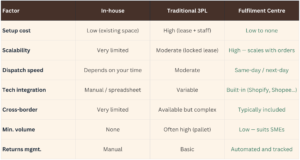
For most growing Singapore e-commerce brands doing 50–5,000 orders per month, a dedicated fulfilment centre wins on every dimension that actually affects customer experience.
How to Choose the Right Fulfilment Centre in Singapore
There are several fulfilment providers operating in Singapore, and the quality differences are significant. Here’s what to evaluate before you commit.
Platform integrations
Your fulfilment centre should connect natively with wherever you sell — Shopify, WooCommerce, Shopee, Lazada, TikTok Shop, or a custom storefront. Avoid providers that require manual order uploads; automation is the entire point.
Pricing transparency
Ask for a full rate card upfront. Hidden fees for receiving, returns, special handling and monthly minimums are common in this industry. The headline pick-and-pack rate rarely tells the whole story.
Cut-off times and dispatch SLAs
What time must an order arrive to be shipped same-day? Is that guarantee in your contract? Singapore customers are accustomed to speed, so a provider with a 4pm cut-off and next-morning delivery is meaningfully more valuable than one with a 1pm cut-off.
Inventory accuracy and technology
Ask about their pick accuracy rate (99%+ is the industry benchmark) and whether you get a real-time dashboard. Poor inventory accuracy leads directly to overselling and stockouts — two things that destroy your seller ratings.
Regional shipping capability
If you sell or plan to sell into Malaysia, Indonesia, Thailand or the wider ASEAN region, confirm that your fulfilment partner has established carrier relationships and experience handling customs documentation for those destinations.
Minimum commitment requirements
Some providers require a minimum monthly order count or storage spend. If you’re still in a growth phase, find a fulfilment centre in Singapore that works with your current volume without penalising you for it.
How ZoomZoomShip Makes Fulfilment Simple for Singapore Sellers
ZoomZoomShip is a Singapore-based ecommerce fulfilment company built specifically for online brands that want to grow — without growing pains. We handle everything from the moment your stock arrives at our facility to the moment your customer signs for their parcel.
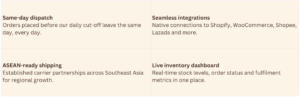
Whether you’re shipping 100 orders a month or 10,000, our model scales with you — no punishing minimums, no surprise fees. We work with beauty brands, fashion labels, supplement companies, electronics sellers and more across Singapore and the region.
Ready to talk?
If you’re spending more than 15 hours a week on fulfilment-related tasks, there’s almost certainly a compelling case for outsourcing. Reach out to the ZoomZoomShip team for a free fulfilment audit — we’ll show you exactly what it would cost and save.
Ready to stop packing boxes yourself?
Let ZoomZoomShip — Singapore’s dedicated ecommerce fulfilment partner — take logistics off your plate so you can focus on growing your brand.
Contact us: hello@zoomzoomship.com | www.zoomzoomship.com
Frequently Asked Questions
A warehouse stores goods in bulk. A fulfilment centre is designed to process individual customer orders at high speed — it has pick-and-pack stations, carrier integrations, barcode scanning, and customer-facing operations built in. Most traditional warehouses are not set up for e-commerce order volumes.
Costs vary by provider, but typically include a storage fee (per cubic metre or bin per month), a per-order pick-and-pack fee, and outbound shipping costs. The exact figures depend on your product dimensions, order volume and packaging requirements. The best way to get an accurate number is to request a quote with your actual order data.
Absolutely. Many Singapore fulfilment centres, including ZoomZoomShip, are designed for SMEs. You don’t need to be shipping thousands of orders a month to benefit — even 50 to 100 orders a month can justify the cost once you factor in your own time and packaging materials.
Most fulfilment centres can onboard a new merchant within 5–10 business days, once your store integration is set up and your first stock shipment arrives. At ZoomZoomShip, we aim to get new clients live within a week of signing up.
Your fulfilment centre handles the inbound return, inspects the item, determines if it’s resaleable, and either restocks it or flags it for your review — all logged in your dashboard in real time.
At ZoomZoomShip, you can use our negotiated carrier rates (which are typically lower than what an individual SME can access) or bring your own carrier accounts. We work with your preferred setup.